The Glendale Cemeteries
The following story about the
Glendale Cemeteries was furnished by Mr. Clarence Crocker, a
life long Glendale resident. Mr. Crocker
started to work for Glendale Mills in 1948. Part of
his first job was responsibility for things dealing
with the Village and the cemetery was part of that.
Records show that the village of
Bivingsville (Glendale) began (1830-32) with the
Bivingsville Manufacturing Co. or Bivingsville Cotton
Mills as it was also called, having some twelve
houses, a Community Church and a shop or two.
Beside the Community Church, where the present
Methodist Church building stands today, Glendale’s
first cemetery was begun on land donated by the
Company. Many of Glendale’s first village and
community residents are buried there. Though the
cemetery was primarily for mill employees and their
families, as time passed, the village and community
enlarging and the number of persons increasing and
dying, the cemetery became filled and a new cemetery
just outside the village on the Glendale-Clifton road
was begun on land also donated by the Company. Though
I know of no record as to when it was started, in a
quick walk in the cemetery I saw one grave marked 1888
and quite a few in the 1890s.
In the early days, families buried their own dead. A
couple in Glendale, Mr. “Lit” and Linder Porter would
come to your home when requested and prepare the
corpse, bathing, dressing and oft times placing
coins on the eye lids to keep the eyes closed for
burying. Some families would transport their own dead
to the cemetery in their wagons or have someone else
carry them. Though the Methodist Church assumed
responsibility for the cemetery beside their church
early on, Mr. Jim Thompson who lived near in one of
the companies farm houses, was for many years in
charge of the new cemetery, assigning grave lots and
digging graves. Though funeral homes had long since
been established in the area, one in 1886, another in
1900, the company had built a tool shed at the far end
of the cemetery where tools for digging graves were
available for any family who wished to dig the grave
for their deceased or they could contract with Mr.
Thompson to dig the grave.
In talking with an Executive of the S. C. Morticians
Association recently, I was told that as late as
1925-30 some people in South Carolina were still
burying their dead. While he told me that no law
requires a body to be embalmed, the practice was
started as early as the 1860s during the civil war.
When returning the soldiers who had been killed on the
battle field to their families, the army embalmed the
body before shipment. As I understood him, there is no
law in South Carolina that prevents a family from
burying their dead today provided they get proper
medical certification.
With culture, ethics and the laws concerning the dead
and burial changed and all interments being done by
morticians, having no longer need for such, we had the
tool shed torn down and the tools removed in
1949. The spot where the tool shed stood is now
a family square.
At that time, the County was allowed to do community
work and we arranged to have the cemetery cleaned at
least once a year by the chain gang. Working through
the churches of the community, dinners were prepared
for the prisoners. The chain gang set up tables for
the meals. The meals were of great variety and
wholesome.
Noticing one day that the prisoner’s choices were
deviled eggs, casseroles, sandwiches, and other fancy
foods, I asked one why they weren’t eating pintos,
cornbread, etc that put meat on the bone, “foot“ he
said, we get that seven days a week when we are at the
camp. When the Company was sold in 1957, the
cemeteries were left to the responsibility of the
families, churches and community. Some families have
indeed taken interest in the resting place of their
loved ones. Some have outlined their square with
granite logs and filled it with granite sand or
stones.
Naomi Bagwell had two rock columns built at the upper
entrance in 1959 in memory of loved ones interred in
the cemetery.
In 1994, Martha Crocker Dearybury, Donnie and Ronnie
Ward organized a Glendale re-union which
was held in the old Mill Store area to raise
funds for Cemetery purposes. From that humble
beginning, The Glendale Cemetery Committee was
organized and a Fund was set up. Each year funds are
raised through stews, selling videos, books and
solicitation to care for the cemetery. With these
funds, they have been able to change the old rutty
dirt road through the cemetery into a nice, smooth,
paved road. They have placed barrels for waste
collection along the road side and have kept the grass
mowed. Martha died in 2008 and today Donnie and Ronnie
along with other volunteers are carrying the good work
on. We who have loved ones buried in the cemeteries
should certainly show our appreciation by words of
encouragement and support. Click on this link, Glendale Cemetery
Committee Fund, for more information and how to
join this group.
A listing has been made in November, 2014 showing the
Veterans buried in the Glendale Community Cemetery.
Click on Veterans to read
this list.
Footnote; I don’t have records supporting this but a
number of Glendale old-timers from back in the late
1800s and early 1900s told me this story.
A certain Glendale man’s wife died. (I withhold the
name.) He was carrying her to the cemetery in his
wagon. The wagon hit a bump and he heard a groan.
Opening the casket he saw perspiration on her face. He
whirled around quickly going back home. He called Dr.
Smith, village Doctor, who said she was dead now but
not when she had been placed into the casket. Putting
the casket back into the wagon he returned to the
cemetery. Just as he approached the rutty bump in the
road, some of the mourners who were walking behind the
wagon vowed that they heard him say to his horse,
“watch that bump Maude, watch that bump”.
Well, be that as it may be, It has been commonly
acknowledged that in the old days, some were perhaps
in a coma and buried alive through a grave mistake.
(Editor Comment - The fear of being buried alive
was widespread before the days of embalming. There
were several devices invented so that the entombed
person could communicate with those left behind.
These included bells on the surface that could be
rung from inside the casket and speaking tubes
from the casket to above ground.)

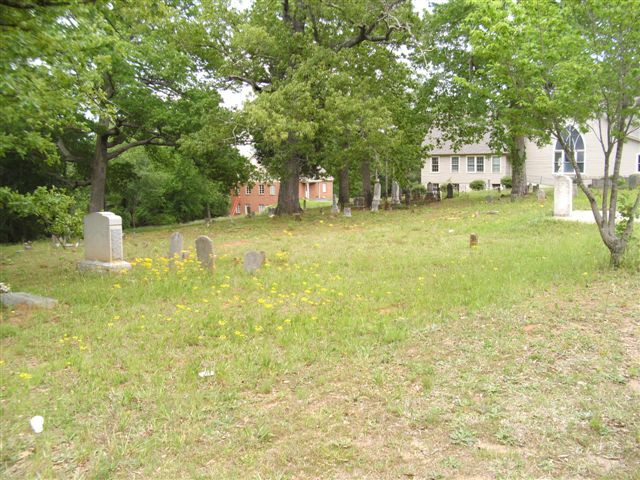
The old Bivingsville, Glendale Cemetery beside
the Methodist Church.
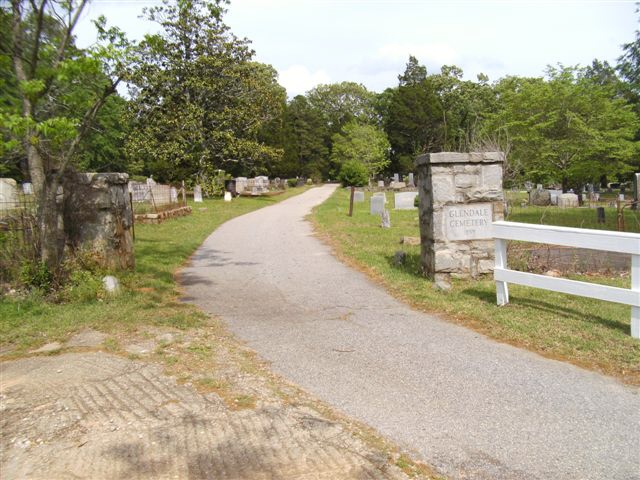
The new Glendale cemetery on
Glendale-Clifton road.
Note from Web Master Mary McKinney Teaster -
I have numerous relatives buried in this Glendale/Clifton
Road cemetery. My Corn relatives buried there are: John
Lafayette and Charlotte Flinn Corn, my Great Grandparents,
Great Aunts Bessie May, Ada Victoria, Sallie Carene, Great
Uncle Arthur, and Great Great Uncle William Walker Corn. (See Corn Family.) Grandmother
Charlotte Flinn Corn's sister, Elizabeth Flinn, married
Gabriel Coates and they also lived at Glendale. I don't
have the records of how many of those relatives, but I'm
sure there are quite a few, are buried there. (See Coates Family.) Great
Uncle Charles Blaine Corn married Susie Crocker and both
are there. (See Crocker
Family.) I may have more there. I haven't been back
to the cemetery in years. I used to pass
the cemetery several times a day but I moved away,
almost all my relatives are gone from the Glendale
community, and my parents' land and house are sold.
It's hard to go back.
This web site has been
started as a public service to share the story of
Glendale. See more information about Mary and
her Glendale connection at Mary
McKinney Teaster.