I hold papers which show that in
1891 Mr. Dexter Converse, President of D.E. Converse
Company, Glendale, S.C. along with his
associates formed the Spartanburg Bell Electric
Railway and Transportation Co. Their intent was to
provide electric railway service from Forest City N.C.
to Clifton, Glendale, Pacolet Mills and on to Glen
Springs, S.C. which was at that time a resort town
being famous for it’s mineral water. Controversy and
conflict stopped the project.
While some records show trolley service (commonly
called street car) began to Glendale in 1903-4, I hold
a record which states that the Spartanburg Railway,
Gas and Electric Company which was founded in 1900
started electric street car service over a 15
mile stretch between Saxon, Glendale and Clifton
in 1906. You take your pick of the date. Destined to
be the areas chief mode of travel for it’s residents
and transportation of supplies and products to and
from the mills, it was especially popular during
county fair week as all the family could ride to
within a block of the fair gate.
State public utility records show that from 1912-27
the company’s name was listed as S.C. Light, Power and
Railway service. Duke Power was listed as
owner-operator after 1928 until the day the trolley
stopped running. Mail and newspapers were
brought to Glendale daily. A person could have a
prescription or other items sent from Spartanburg by
the Trolley when needed. The supplier would hand the
addressed item to the conductor and the recipient
would meet the Trolley to receive it.
With a terminal located at the “Band-Stand” on the
Square in Spartanburg, passengers got off to trade
uptown or could change “Trolleys” and continue on to
other locations in the greater Spartanburg area.
Restrooms were provided in the basement of the
Band-Stand. Bands and shows performed on the top
of the open air bandstand. Some people would go to
Spartanburg just to see and hear their favorite band
or comedian. The Blue Bird Ice Cream store was just
across the street as a special topping for one’s trip.
The Trolleys were run by electricity provided by a
long electrode protruding from each end at the top of
the car and gliding along the power line above. The
car did not turn around. A conductor’s seat was at
each end as well as a door for getting on-off the car.
When the car reached the end of the line, the
conductor would go outside and by a long rope, pull
the electrode down at one end and raising the one at
the other end to make contact with the electric power
reversing it’s direction.
When the Trolley passed through Glendale, there
were places where boys would hide behind bushes then
run out and pull the electrode off the wire which
stopped the car. The conductor would have to get out
and align the electrode with the power line again.
Though it must have been aggravating, they seem to
have taken it in their stride knowing that boys would
be boys.
Regular passenger trolleys were too light and
didn’t have enough power to push box cars of coal,
cotton and other supplies to the mill. A special large
electric car called “The Big Six” was used for this
purpose. The trolley and “Big-Six” served the
community and surrounding areas well during their life
time of some thirty years having stopped running in
1935.
While there were no doubt others, Glendale men whom I
have record serving as conductors on the Trolleys
were, Elbert Knox, Andrew McKinney, Bryan Fowler,
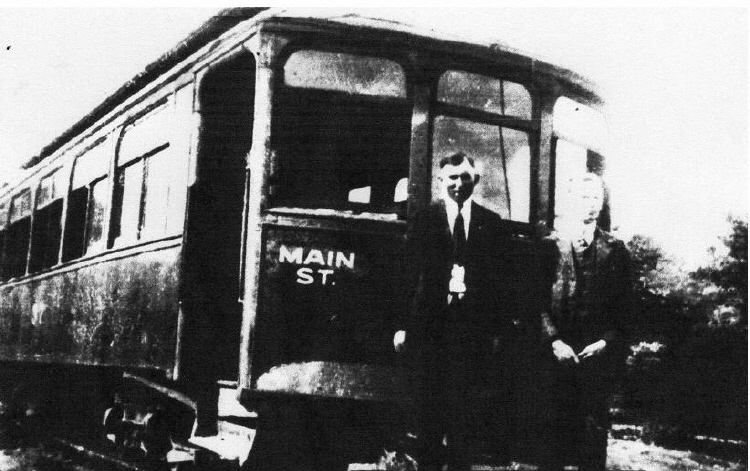
Elbert Black and Elbert Pierce. In the picture shown
below, Elbert Pierce with Dan Crawley, his supervisor,
is seen at the end of the last run of the Trolley in
Spartanburg County which was the route to Glendale and
the Clifton’s in 1935. Buses took the place of the
Trolleys with Elbert Pierce, Elbert Black, Bryan
Fowler and Buster Reaves, all of Glendale becoming bus
drivers.