(Although some of these men are
referenced in other articles which I have written
relating to the Bivingsville/Glendale Mills, I
feel it would be beneficial to list the Presidents
collectively in one story for history’s sake.)
According to the records which I
have, the Bivingsville Manufacturing Company,
Bivingsville, S.C., having fallen into bankruptcy, was
sold to John Bomar Jr. and his associates at a Sheriff’s
sale for $19,500 in 1856. The plant operated under the
name of J. Bomar & Company until the death of Mr. John
Bomar in 1868. Following his death, Dexter Converse,
Albert Twichell and J.C. Zimmerman, having bought the
stock of all other owners, reorganized the company in
1870. The name was changed to The D. E. Converse Company
with Dexter E. Converse being named President.
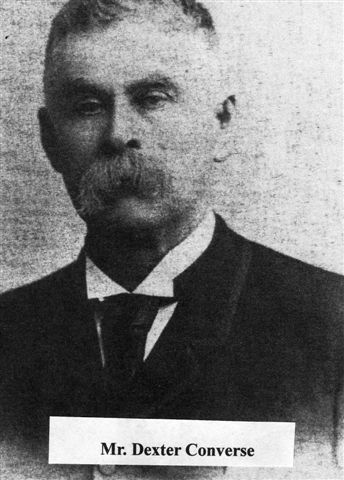
When Dexter Edgar Converse came to
Bivingsville in 1855, his salary was set at $50 per month
plus free board for himself in the “Bivings Mansion” which
had been turned into a boarding house. After he married,
he was required to pay board for his wife out of his
salary. From those humble beginnings, his ingenuity,
business expertise and textile knowledge moved him from
the title, “mill operative” to becoming the major stock
holder of the mill and the house he had lived in as a
boarder as well as becoming the first President of
the company.
The newly organized D. E. Converse
Company consisted of the Glendale plant only. By
1875, in addition to the cloth manufacturing plant, the
company was operating a grist mill, a cotton gin, a saw
mill, a machine and carpenter shop. Glendale was being
called, “the showplace of the county“.
At the proposal of Mr. Converse, the Clifton Manufacturing
Company was organized in January of 1880 for the purpose
of building a cotton mill plant. Dexter Converse was
chosen as President. In 1881 Clifton Mill #1 went into
production. Clifton Mill #2 was built in 1888. The D. E.
Converse Company, consisting of two divisions, Glendale
Mills and Clifton Mills, was incorporated in 1889. Mr.
Converse was chosen as President of the Corporation. In
1890 Glendale added the second plant. Clifton Mills added
a third plant at Converse in 1896 and Glendale was in the
process of adding its third plant at the time of the
untimely death of Mr. Converse.
Records tell us that Mr. Converse
was a Republican with regards to national affairs but
supported Democratic policy in local matters. Though he
had been ill for a short while, his death on October 4,
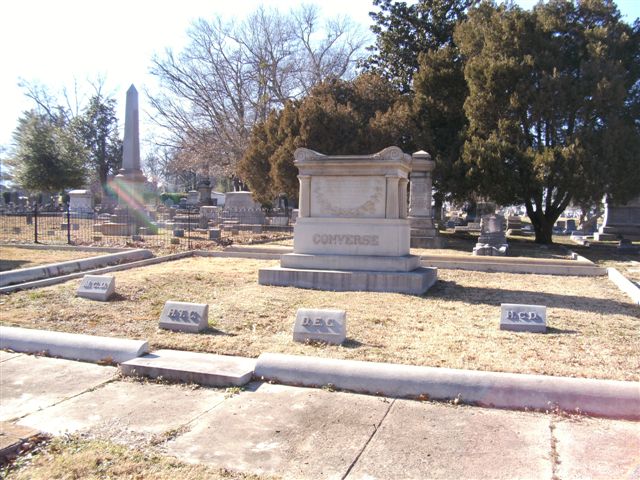
1899 was unexpected. He was laid to rest in the Converse
Square in the Oakwood Cemetery in Spartanburg. S. C.
Click-on the following links Mill
Story and Mill
Superintendents for more details about Mr. Converse.
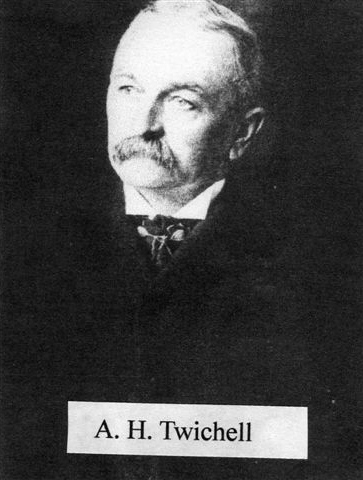
Albert H. Twichell was elected
President of the D. E. Converse Company, Inc. following
the untimely death of his brother in-law, Dexter Converse.
Albert, the son of Mr. Window and Anne Carroll Twichell,
was born February 13, 1841 in New York Mills, N.Y. He came
to Bivingsville in 1859 at the age of 18 following the
invitation of Mr. Converse to work as a bookkeeper and
clerk in the mill store which was under the control of
John Bomar & Company. He continued in that position
until August 1861 when he enlisted in the Thirteenth S.C.
Regiment as a soldier in the Civil War.
Shortly after the war, The John
Bomar Co. having been dissolved and the D. E.
Converse Company organized, the name of the village was
changed from Bivingsville to Glendale, S. C. Postal
records listed Albert Twichell as Postmaster of the newly
opened Glendale Post Office in 1878. Having bought stock
in the Company, Mr. Twichell became a partner in the firm
and was named Secretary and Treasurer of the D. E.
Converse Company. He served in that position until he was
elected President of the Corporation in 1899, making
him head of both Glendale Mills and Clifton Mfg. Co.
The Corporation continued to grow under his leadership.
Plant No 3 at Glendale was finished in 1902.
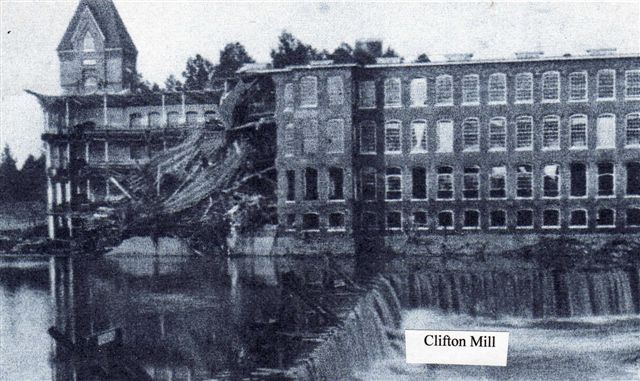
Unfortunately the flood of 1903,
doing extensive damage to all the mills, resulted in
great loss for the Corporation and it’s employees.
Fortunately, Glendale did not suffer the loss that Clifton
did. Their mills were devastated, homes were washed away
and lives were lost. Reportedly, four to five hundred
thousand dollars, perhaps much more, was reinvested in the
Company and under the capable leadership of Mr. Twichell,
all plants were rebuilt and expanded.
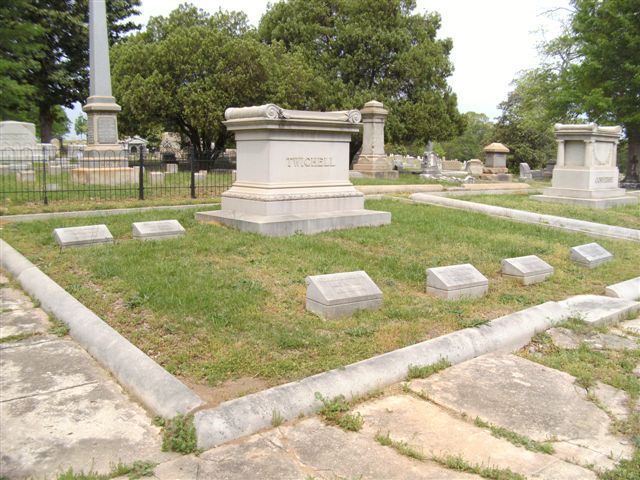
Mr. Twichell married Miss. Mary
Bomar of Charleston, S. C. in 1866. She was born January
27, 1842 and was the daughter of George W (May
8,1807-July16,1886) and Emily C. Bomar
(Aug.16,1816-Oct.11,1896) Both parents are buried in the
Twichell Square in Oakwood Cemetery in Spartanburg, S.C.
Albert and Mary Twichell were the parents of two
daughters; Nellie Converse Twichell, born July 31,1867.
Nellie married David Meiver of N.Y. She died December 15,
1934 and is buried in the Twichell square in the Oakwood
Cemetery. Emma was born August 8, 1871 and married
Jefferson Choice Evins of Spartanburg. She died March 13,
1944 and was interred in the Evins Square at Oakwood
Cemetery. Mrs. Mary Bomar Twichell died January 19, 1905
and is also interred in the Twichell Square in the Oakwood
Cemetery along side of her husband. Copies of her obituary
were not available.
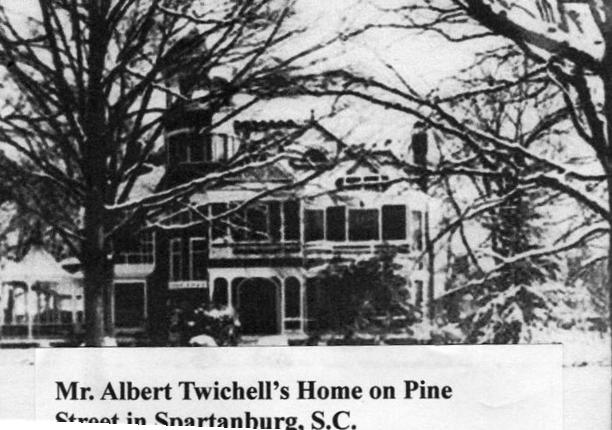
Mr. Twichell built a new home on
Pine Street in Spartanburg in the 1880s into which he and
the family moved. While some reports show 1882, I cannot
confirm the exact date. The organizational meeting of the
Spartanburg Country Club was held in his home in 1908. He
was a music leader in the First Presbyterian Church of
Spartanburg. He served as President of the Spartanburg
Musical festival for some 20 years. The Twichell
Auditorium at Converse College was named in his honor and
the Music Festival continues as an annual affair.
After the death of his first wife,
Mr. Twichell married Janie Rivers of Spartanburg. She was
born January 26, 1873, the daughter of Mr. Mallory and
Corrie Vance Rivers. She was a graduate of Converse
College and a member of the First Presbyterian Church of
Spartanburg, S.C. She died on August 3, 1965.
Her obituary published August 4,
1965 Spartanburg Herald, reads; Mrs. Janie Rivers
Twichell, 93, of 172 Alabama Street, widow of textile man
Albert H. Twichell, died Tuesday at Mary Black Hospital
after a long illness. Her only survivors being; one
sister, Miss Sara Rivers of the home, 172 Alabama Street,
Spartanburg, S.C., one grandchild and two great
grandchildren. Graveside services were held at the Oakwood
Cemetery where she also was interred along side of her
husband in the Twichell square.
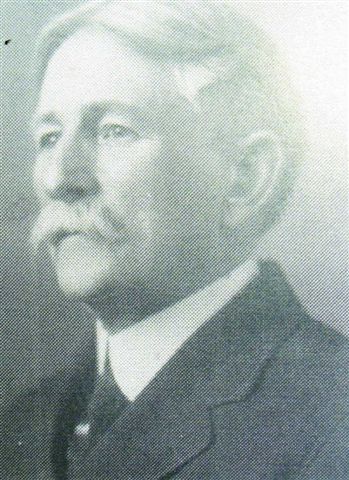
Mr. Twichell died on May 28,1916 and was interred in the
Twichell Square in the Oakwood Cemetery. Unfortunately no
copy of his obituary was available. Birth and death dates
taken from the grave markers by this writer.
Click on the following link, Mill
Story, for more details about Mr. Twichell.
Mr. Wilton E. Lindsay
Following the death of Mr. Twichell,
each of the two divisions of the D. E. Converse
Corporation chose their own President.
Wilton. E. Lindsay, born in Charleston S. C. on December
7, 1858, came to Glendale in 1879 or 80 (two different
dates appear in records) to serve as a bookkeeper for the
D. E. Converse Company, Glendale Division. He was later
chosen as Company Secretary. He continued to hold this
office after being elected President of the D. E. Converse
Company, Glendale Division, in 1916.
The “Bivings House” which was now owned by the Company,
was continuing to be used as a boarding house in
which Mr. Lindsay was living when he married Miss Ella Tew
in 1882. Born October 24,1861, Ella Tew was a native
of Hillsboro, N.C. and was the daughter of Charles
Courtenay and Elizabeth Tradewell Tew. It appears that
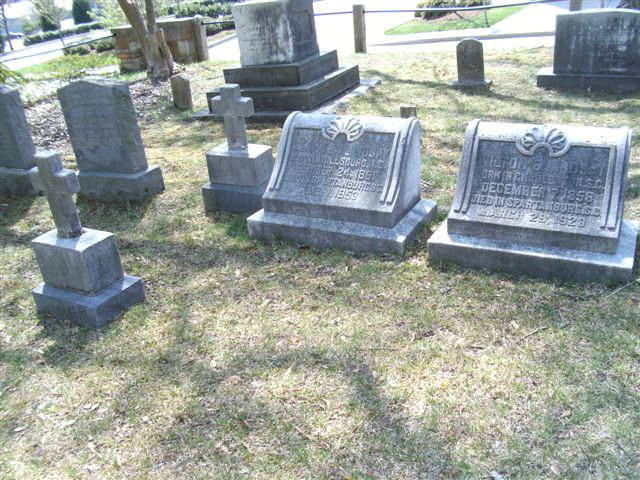
Wilton and Ella were the parents of five children. Two
infants, which apparently died the day of birth, are
buried on the right side of Mrs. Lindsey. I could not
discern the names on the tombs but one was dated October
21,1886 and the other, August 18, 1888. They had a
daughter, Ella Tew Lindsay and two sons, Courtenay T. and
Charles M. Lindsay which were reared at Glendale in the
Bivings House.
Though water had been run from the
mill to the Bivings and Twichell’s homes long before,
residents of the village were continuing to get their
water from wells strategically located throughout the
village until 1917. One hand pump was installed on the
well behind the Bivings home where residents of the first
twelve houses built on Main Street in Bivingsville, were
able to get their water.
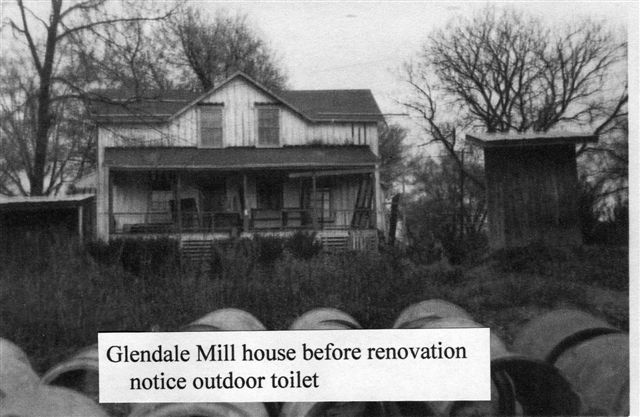
Outdoor toilets were being used by
the residents of the village while mill sewage empted into
the river. In his report to the State Industrial
commission in 1918, Mr. Lindsay reported the installation
of septic tank water toilets in the village houses
indicating that water had been installed in the homes in
1917. He also announced that he had contracted for village
lights. A new movie projector had also been installed in
the community building.
.
Mr. Lindsay died on March 29, 1928 at the age of 69 and
was buried in the Lindsay Square in the Church of Advent
Cemetery on Advent Street in Spartanburg, S.C.
Unfortunately, I have been unable to obtain a copy of his
obituary but we know that he was survived by his wife, one
daughter and two sons.
Mrs. Lindsay’s obituary published in
the Spartanburg Journal Monday June 1, 1953, stated that
she had died that morning after a long illness at her
home 520 Glendalyn Ave. Spartanburg. Her funeral
service was held at the Church of Advent where she was
recognized as having been the oldest living member. She
was 91 years of age. Interment followed in the Church
Cemetery between her husband, and two infant children. She
was survived by a daughter, Mrs. Ella L. Ferguson of
Spartanburg and two sons, Courtenay T. of Deland Fla. and
Charles M. of Spartanburg. Also two grand-daughters, two
grandsons and four great grandchildren. Ella, who was born
August 11,1900 died April 23,1981. She had married John R.
Ferguson who was born June 18,1898 and died December
12,1937. Both are buried in the Lindsay Square in the
Church of Advent Cemetery in Spartanburg.
(Dates taken from grave monuments by this writer. )
Mr. J.Choice Evins
Following the death of Mr. Albert
Twichell in 1916, his son in-law, J. Choice Evins, became
the President and treasurer of the Clifton Manufacturing
Company and became President and treasurer of the D. E.
Converse Corporation(Glendale/Clifton) in 1928 following
the death of Mr. Lindsey. He continued in this position
until his death on August 14, 1945. Mr. Evins was a native
of Spartanburg and was born June 5, 1869, the son of John
and Henrietta Choice Evins. He was a graduate of Wofford
College of Spartanburg with an A. B. degree. After
finishing school, Mr. Evins taught school in Georgetown
before returning to Spartanburg to become a partner in the
founding of the Central National Bank. He had been
assistant treasurer of Clifton Mills since 1902.
On September 16, 1896, he married
Miss Emma Bomar Twichell. The daughter of Albert H. and
Mary Bomar Twichell, she was born in Glendale, S. C. on
August 8,1871. Educated in private schools as a young
girl, she later attended Stewart Hall, Staunton, Va. and
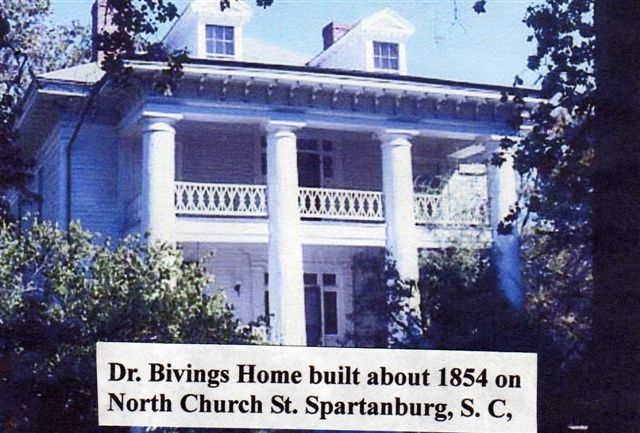
Boston Conservatory. The Evins lived in their home on
North Church Street which was built by his Uncle,
Dr. James Bivings, founder of Bivingsville. Dr. Bivings
had sold the house to John Evins, his brother in-law, the
father of J. Choice. Evins.
Mr. Evins served as President of the
S.C. Cotton Mfg. Association and was also a Director of
Jackson Mills at Welford and the Hartsville Mills. He had
served as a Trustee of Converse College, a member of the
Kennedy Library Board and the advisory board of the
Citizens and Southern National Bank. He was a member of
the First Presbyterian Church where he was honored for his
service as a Elder for 50 years.
Mrs. Evins died on March 13, 1944, eighteen months before
her husband. Her obituary published on Tuesday, March 14,
1944 in the Spartanburg Journal stated that she had
died at a local hospital the day before. Her funeral
service was to be held that afternoon at the First
Presbyterian Church of Spartanburg where she had been a
life long member. Interment was in the Evins Square in the
Oakwood Cemetery. Among her survivors were, her husband of
the home, 563 N. Church Street, Spartanburg, S.C. and her
niece, Mrs. H. E. Correll, a great niece, Mrs. David Peck,
a great nephew, A.T. Correll and two
great-great nephews, David and Albett Peck.
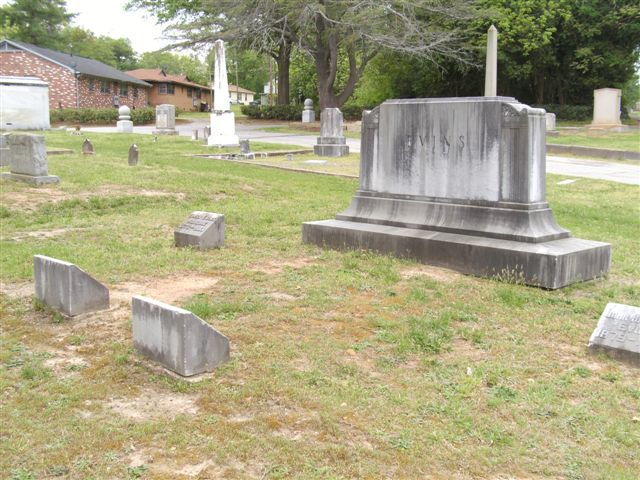
Mr. Evins obituary published in the Spartanburg Journal
on Wednesday August 15,1945, stated that Mr. Evins, 76, had
died on Tuesday August 14th at a Charlotte, N.C. hospital.
Funeral services were held in the First Presbyterian Church
with burial following in the Evins Square in the Oakwood
Cemetery along side of his wife. He was survived by a
brother, Cleveland Evins of San Pedro, Calif. Four nieces,
Harriet Evins Sinclair, Emily Twichell Fitchett, Emily C.
Evins and Sara E. Evins. Five nephews, J.C. Jr., Elliott D.,
S. N., Thomas M. and Thomas A. Evins.
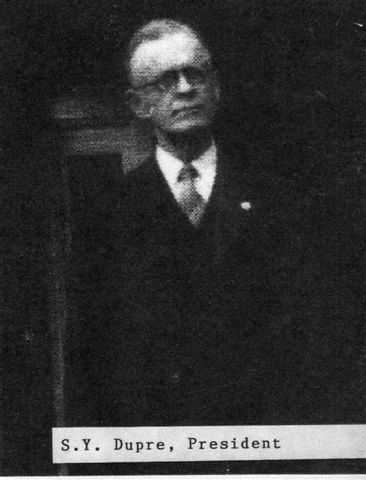
Samuel Jervey DuPre Sr., a native of
Mt. Pleasant, S.C. and a graduate of the Citadel, had been
serving as Company Secretary & Treasurer and was
elected President & Treasurer of The D. E. Converse
Company, Glendale Mills, in 1945 following the death of
Mr. Choice Evins. He continued to serve in these
capacities until his retirement in 1947 following the sale
of the D.E. Converse Company, Glendale Division, to J. L.
Stifel and Co. of Wheeling, West Virginia.
Having known Wilton Lindsay who had
come to Glendale in 1879-80, Jervey came to Glendale in
1897, boarding some twelve years with Mr. and Mrs. Lindsey
in the “Bivings” house. He began work on the cotton
platform, weighing cotton being brought to the mill by
farmers. Before he had retired, he had worked in most
every department of the mill, retiring as President and
Treasurer of the Company.
Having worked at Glendale some 50
years, Mr. DuPre was a walking, talking history book of
Glendale Mills and the village. He recalled and told about
the construction of the Trolley car tracks and the Trolley
operation. He delighted in talking about the “ Park”,
located on the edge of the waters of Lawson Fork
just as it ran through the village. It contained picnic
pavilions and was widely used, drawing crowds
from all over the county. He loved to tell how he, Dr.
William F. Smith, the community Doctor and S.F. Sutton
went to Inman to get a Charter for the Glendale Masonic
Lodge in 1907.The trip took all night traveling in what
Mr. DuPre referred to as a “hack” In an interview with a
Spartanburg Herald reporter in January of 1947, Mr. DuPre
related how he had bought his first car from Sear’s
Roebuck. It was a 1909 model which he reported, “looked
like a fine buggy except it didn’t have a whip”. He told
how the community was “startled” by him being able to go
to Inman and back (34 miles) all in one day.
Though he was President and Treasurer of the Company, Mr.
DuPre never stopped caring for and helping the people
among whom he worked. He always found time to stop and
give an ear to their problems. He didn’t mind getting his
hands dirty and would help in any way he could. Mr. DuPre
did survey work on the side for many home and property
owners in the area. He did survey work for my dad on a
number of occasions as he purchased property, including
the division of my father’s property for the purpose of
his final will. He and my dad were good friends. I have
known Mr. DuPre all my life and considered him a personal
friend. His word was his bond. It was Mr. DuPre who asked
my dad in 1946 to tell me to come see him about applying
for the job as Post Master at Glendale. I found him to be
all business, but kind and considerate. He was greatly
appreciated by the employees of the Company and the
residents of the community.
Mr. DuPre married Hallie Mathews, a
native of Montgomery, Ala. She was the daughter of Henry
H. and Mary Charles Mathews. They were the parents of six
children, Their son John Y. was the Cotton buyer for
Glendale Mills for many years. Mr. DuPre and his family
lived in the Glendale village for a number of years before
moving to their new home in Spartanburg
Mr. DuPre’s obituary published on Saturday April 6 in the
Spartanburg Herald Journal, stated that he had died on
Friday, April 5, 1957 at his home at 532 Glendalyn Ave. in
Spartanburg. He was survived by his wife, three sons,
Henry, John and S. Jervey Jr., all of Spartanburg. Three
daughters, Mrs. Cleveland Beatle of Greenville, S.C., Mrs.
Kenneth Donaldson and Mrs. W. S Royal of Mt. Pleasant,
S.C. One sister, Mrs. Lee Royal of Mt. Pleasant and 15
grandchildren. He was 82 years of age and was a member of
the Church of Advent. His funeral service was held at the
J. F. Floyd Mortuary with burial following in the
Greenlawn Memorial Gardens.
Mrs. Hallie Mathews DuPre, 74, died on June 14, 1958. Her
obituary published on June 14, 1958 in the Spartanburg
Journal, stated that she had died that morning at the
Spartanburg General Hospital after a long illness. She was
a member of the Episcopal Church of Advent. Graveside
services were held at Greenlawn Memorial Gardens where she
was interred. In addition to her six children listed as
survivors of her husband, she was survived by three
sisters, Miss Emily Matthews, Mrs. Frank Mathews and Mrs.
J.A. (last name not listed). Also 16 grandchildren,
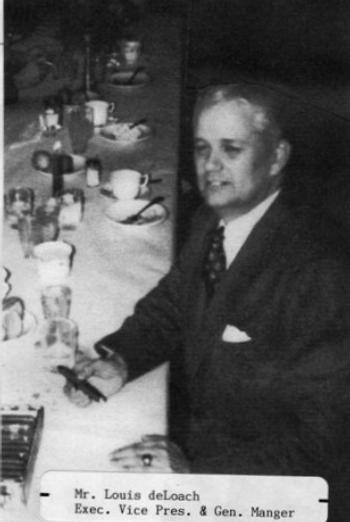
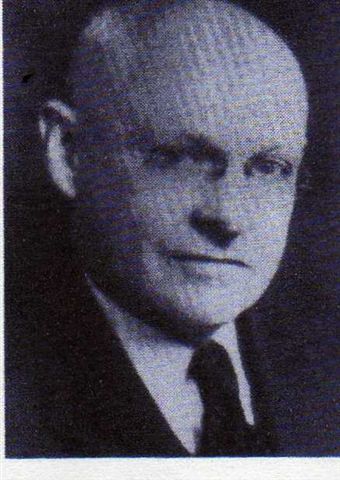
Following the sale of The D. E.
Converse Co., Glendale Division, to J. L. Stifel and Sons
of Wheeling West Virginia in 1946, Louis Douglas deLoach
came to Glendale in 1947 to become the Executive
Vice President and General Manager of the operation. A
native of Yemassee, S.C., he was the son of William
Bratton and Josephine Kershaw deLoach and was reared in
Camden, S.C.
Studying two years at Clemson, he graduated from Georgia
Tech in 1927 with a B. S. degree in textiles. After
finishing school, he went with Manville Jenches in High
Shoals, N.C. as a learner and Assistant Superintendent.
Moving to Mayfair Mills in Arcadia, S.C. in 1938 where he
served as Vice President and General Manager. Leaving
Mayfair in 1942, he went to Springs Cotton Mills,
Lancaster, S.C. from which he came to Glendale.
Arriving in Glendale he found the mill as well as the
village in dire need of upgrading. He immediately
announced and started work on a million and half dollar
program of renovation and improvement. The mill was still
being powered by a waterwheel, turbines and steam engines
and was lighted with incandescent lights. Departments
lacked consolidation. The interior walls and ceilings of
the mill were in dire need of a fresh coat of paint.
Improvements began by thoroughly painting the mill‘s
interior. Fluorescent lights replaced incandescent. New or
rebuilt machinery replaced outmoded or worn-out machines.
Departments were consolidated. Machinery was individually
motorized. The water wheel, turbines and steam engines
were discontinued and removed. A new electric grid was
built providing a more dependable power source for both
mill and village. Spinning and weaving additions
were added to the plant. A new elevator was installed plus
many other improvements
Large sewage treatment tanks and
drying beds were built behind the mill. The mill sewage
which had emptied into the river for some 100 years was
turned to the collection tanks and drying beds.
Sewer lines were installed throughout the village and all
village sewage was collected for treatment along with the
mill sewage before empting into the river. Village septic
tanks which were installed in 1917, were discontinued.
The village houses, 4,5, and 6 rooms with a toilet on the
back porch, were is terrible shape. Many if not most, were
more than a hundred years old. Most had only had a few
coats of whitewash or paint since being built. The
bathroom was limited to a water toilet and a laboratory.
None were wired for hot water heaters. Many were torn
down, some were moved but every house left standing was
completely remodeled with modern bathrooms, hot water and
new electrical wiring. New windows, doors, siding and
roofing was also installed. A few new homes were built. A
new gymnasium was built. The mill store was renovated. The
Masonic Lodge was remodeled. Village streets were renamed
and marked with street signs. Dropping the words, D.E.
Converse Co., the plant became known simply as “Glendale
Mills”.
After the village homes had been totally renovated, they
were offered for sell, giving many employees who had never
dreamed of owning his or her own home, the chance to buy.
Mr. deLoach’s leadership had a tremendous impact on
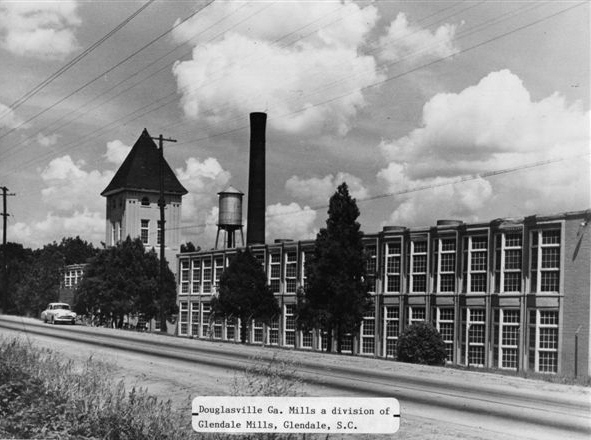
the mill, the village and the people. Under his
leadership, the Douglasville Cotton Mill in Douglasville,
Ga. was purchased and put back into operation.